Purple Patch
Batters who enjoyed a Bradmanesque spell in Tests

Ravindra Jadeja, the Test batter, is in red-hot form — averaging 103.3 across his last 11 innings since the Leeds Test on 20 June 2025. In cricketing parlance, he is having a Bradmanesque average which is a tribute to his remarkable batting average of 99.94. What Jadeja has sustained over four and a half months, Bradman upheld across a 70-innings career spanning nearly two decades, interrupted by World War II and limited fixtures. His is such an outlier that no other batter with at least 5000 Test runs managed to touch 60, the next best average of Ken Barrington (58.56) is 41% lower. Before we dive into players who, like Jadeja now, have produced similar purple patches in their Test careers — let’s take a quick detour into the origins of the term itself.
Why “Purple Patch”?
‘Purple patch’ comes from classical literature, where ‘purple passages’ referred to brilliant, standout sections in otherwise plain text. But the metaphor has a deeper root. In ancient Phoenicia — especially the city of Tyre in what is now modern-day Lebanon — a rare dye made from sea snails produced a deep purple hue so costly it became the color of royalty. Roman emperors later codified this symbolism. Only they could wear Tyrian (not the Lannister!) purple. So, when a cricketer hits a purple patch, it’s not just great form, it’s a flash of regal brilliance.
Criterion: The Bradman Benchmark
At least 10 consecutive innings with 100+ average. It’s a nod to Don Bradman, whose career average of 99.94 stands as the gold standard for batting excellence. This threshold filters out fleeting form and captures sustained peak performance. The dataset includes all Test matches played up to 30 October 2025. A similar article by cricket statistician Anantha Narayanan, published on ESPNcricinfo, looked at the best 52-Test stretches across careers. His focus was long-term impact; this one is about short, brilliant runs.
Between the first recorded streak by Australia’s Jack Ryder, from February 1921 to February 1925, and Ravindra Jadeja’s current run, there have been 117 instances of a batter averaging 100 or more across 10 consecutive Test innings. Here’s the link to the detailed list. Bradman holds the longest and most productive streak — 79 innings over 19.6 years, scoring 6996 runs with 29 hundreds. Bradman’s streak spanned every innings of his career — except the final one, when he was bowled for a duck by Eric Hollies’ googly. He needed just four runs to finish with a career average of 100.
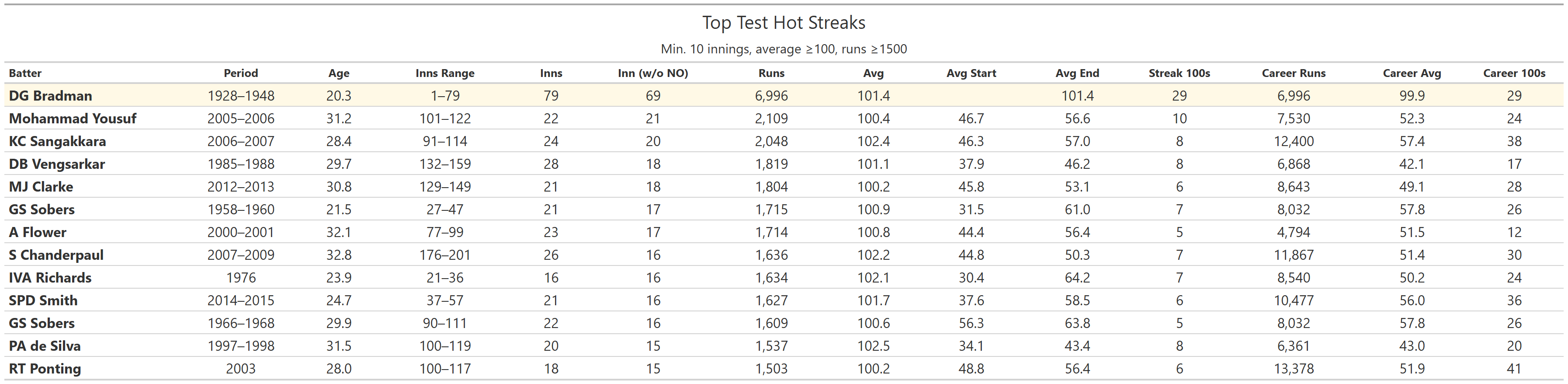
The 1500+ Runs at 100+ Club
Only 12 batters scored 1,500+ runs at 100+ average. Three: Pakistan’s Mohammad Yousuf, Sri Lanka’s Kumar Sangakkara, and the Don himself crossed 2,000
· Mohammad Yousuf (2005–06): 2,109 runs across 21 dismissals with 10 hundreds — six in excess of 170, two double-hundreds. Still holds the record for most Test runs in a calendar year (1,788 in 2006). A rare blend of volume and consistency.
· Kumar Sangakkara (2006–07): 2,048 runs across 20 dismissals, including eight hundreds — seven above 150. Among them: a 287 against South Africa in a record 626-run stand with Mahela Jayawardene, and a fourth-innings 192 chasing 507 in Hobart. His peak overlapped with Yousuf’s.
· Dilip Vengsarkar (1985–88): 1,819 runs in 28 innings with 18 dismissals, producing 8 of his 17 career hundreds — including centuries at Lord’s and Leeds, and a dominant home season with tons against Australia, Pakistan, and West Indies. It lifted his average from 37.9 to 46.2, cementing his place in India’s pre-Tendulkar middle order.
· Michael Clarke (2012–13): 1,804 runs across 21 innings with three not outs, featuring a triple hundred against India at Sydney, three more doubles, and ending with a century in Chennai. He topped the Test batting charts for 2012 — one of the most memorable spells in recent history.
· Garry Sobers (1958–60): 1,715 runs in 21 innings with 17 dismissals, including his maiden Test hundred — a monumental 365* at Sabina Park at age 22. It transformed his reputation, lifting his average from 31.5 to over 61. The only batter with two separate 1,600+ runs streaks at 100+ average.
· Andy Flower (2000–01): 1,714 runs across 23 innings with 17 dismissals, featuring twin masterclasses against India’s spin (183* and 232*) and a 199 against South Africa. During Zimbabwe’s leanest years, he was the lone bulwark — all while keeping wickets. Lifted his average from 47.2 to 54.7.
· Shivnarine Chanderpaul (2007–09): 1,636 runs in 26 innings with 16 dismissals over two years of quiet dominance, often shielding the tail. Featured seven hundreds — five unbeaten — lifting his average from 44.8 to 50. A masterclass in attritional batting.
· Viv Richards (1976): 1,634 runs in just 16 innings, all dismissed — a six-month burst at the height of his swagger. Still ranks second in calendar-year runs after Yousuf. Elevated his stature after an indifferent prior run (348 in 17 innings at 21.75).
· Steve Smith (2014–15): 1,627 runs in 21 innings with 16 dismissals — a defining phase that pushed his career average from 37.61 to 58.53, a level sustained across 155 innings since. His rise to modern greatness.
· Aravinda de Silva (1997–98): 1,537 runs in 20 innings with 15 dismissals, producing 8 of his 20 career hundreds (40% of total). A late-career flourish coinciding with Sri Lanka’s emergence post their 1996 World Cup win.
· Ricky Ponting (2003): 1,503 runs in 18 innings with 15 dismissals, featuring double hundreds against India and South Africa, and twin tons against England. A year that confirmed his role as Australia’s batting anchor post-Waugh.
Batters with Multiple Streaks
Jacques Kallis leads with five streaks of at least 10 innings averaging above 100. Shivnarine Chanderpaul and Steve Waugh both had four such streaks, while Kumar Sangakkara, Steve Smith, Ricky Ponting, Ken Barrington, and Wally Hammond enjoyed three each at different junctures of their careers. These bursts of form significantly boosted their career averages — six of them finished above 50, while Smith continues to hold strong at 56 after 119 Tests.
Agony followed by Ecstasy
For most batters, a prolonged purple patch tends to secure their place. Runs bring reassurance; reassurance earns time. But not everyone is so fortunate. A closer look at players whose Bradmanesque streaks arrived late — within 15 innings of their final Test — reveals a different story. These are careers that peaked just before they ended. First among them: Vinod Kambli and Adam Voges — batters who started with a bang and bowed out quietly.
Kambli burst onto the scene with consecutive double hundreds in his fourth and fifth innings, followed by two more centuries in his next three. No one has ever scored more runs by their 10th Test innings than his 880. Only Sir Everton Weekes came close, with 878 runs—part of his world-record feat of five consecutive Test hundreds, all scored in 1948.
Voges, too, lit up the Test arena late. Debuting at 35, he averaged over 100 deep into his second year, with a double century in Wellington and an unbeaten 269 in Hobart. Yet within months, a dip in form and a concussion in domestic cricket nudged him toward retirement. He finished with an average of 61.87 — second only to Bradman among those with 20 or more Tests — but played his final innings less than two years after his debut.
Andy Flower’s purple patch came deep into his career, averaging over 100 across 23 innings between 2000 and 2001. But with Zimbabwe Cricket in turmoil and his own disillusionment growing, he retired from Tests in late 2002 with a final flourish before stepping away.
Graeme Pollock, Charlie Davis, and Eddie Paynter represent cricket’s cruel what-ifs: Pollock averaged over 100 across 11 innings (1966–70) until apartheid isolation ended his career at 26; Davis scored consistently, including a double century, yet was dropped after 15 Tests amid West Indies’ depth; Paynter blazed 908 runs at 100.89 in 1938–39, only for war and age to sideline him at 37, with England moving on by resumption.
Others timed exits perfectly: Kumar Sangakkara, Steve Waugh, Ken Barrington and Mark Taylor — all signing off in peak form.
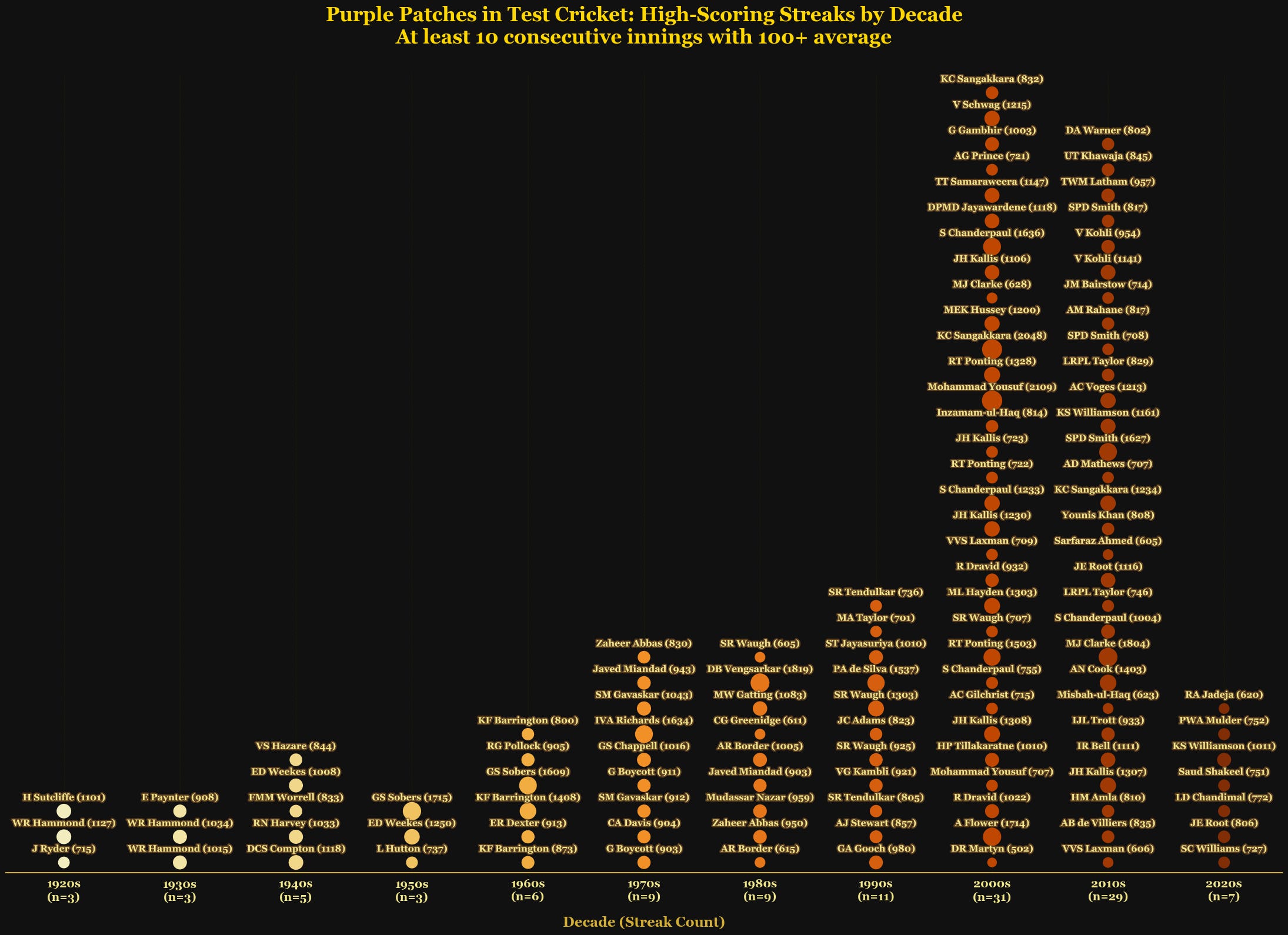
A Century of Purple Patches: From the 1920s to the 2020s
Test cricket’s purple patches — 10-plus innings at a 100-plus average — began as whispers: three in the 1920s (Sutcliffe, Ryder), three in the 1930s (Hammond). The 1940s to ’70s saw steady growth but still sporadic: five, three, six, nine — Sobers twice, Barrington, Richards, Gavaskar. The 1980s (nine) and 1990s (11) marked a global spread, with Border, Tendulkar, and Dravid among the torchbearers.
Then came the golden age: 31 streaks in the 2000s, 29 in the 2010s — flat decks in Asia, true tracks in Australia, and draw-heavy series fed the run-glut. Kallis (five streaks), Sangakkara, Yousuf, Chanderpaul, Ponting, Kohli, Smith feasted.
Post-WTC era (2019 onwards): just seven in the 2020s, or nine if counting from the inaugural cycle. Result-oriented pitches, aggressive tactics, and win-or-bust pressure have dried up the run-glut.
From rare artistry to a spell of abundance to elite survival — the purple patch has evolved with the game itself.